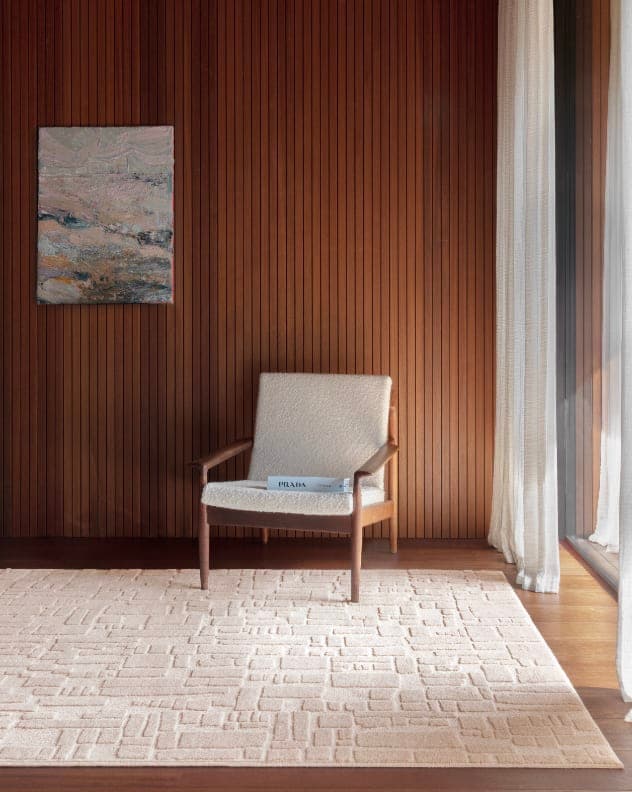
House of Wool makes carpets that are handknotted or handwoven from pure, high-quality wool, rooted in a Belgian textile tradition and intended to be lived on for decades rather than replaced within them. That last clause is the whole point. A great deal of what is sold as a quality rug is built to a price and a fashion cycle; House of Wool is built to a different timescale, and the difference is decided by things most buyers never think to ask about.
On this page
Introduction
House of Wool makes carpets that are handknotted or handwoven from pure, high-quality wool, rooted in a Belgian textile tradition and intended to be lived on for decades rather than replaced within them. That last clause is the whole point. A great deal of what is sold as a quality rug is built to a price and a fashion cycle; House of Wool is built to a different timescale, and the difference is decided by things most buyers never think to ask about.
Why the material is the decision
Wool earns its place underfoot for reasons that have nothing to do with how it looks in a photograph. It is naturally durable and resilient, it is soft underfoot, and it is a genuinely sustainable fibre rather than a marketed one. House of Wool's choice to work in pure, high-quality wool is therefore not a stylistic preference; it is the first and most consequential decision in the whole piece, because the fibre sets the ceiling on everything that follows.
This is also where the honest caveat belongs. Handmade does not automatically mean better than machine-made, and anyone who tells you otherwise is selling rather than explaining. A poor wool worked by hand will shed and break down in a few years; a good wool, well spun and tightly worked, lasts a generation or more. What protects the buyer is not the word "handmade" on a label. It is the quality of the wool and the discipline of the making, which is exactly what a Belgian craft tradition is supposed to guarantee and what cheaper production quietly does not.
Handknotted and handwoven, and why the difference matters
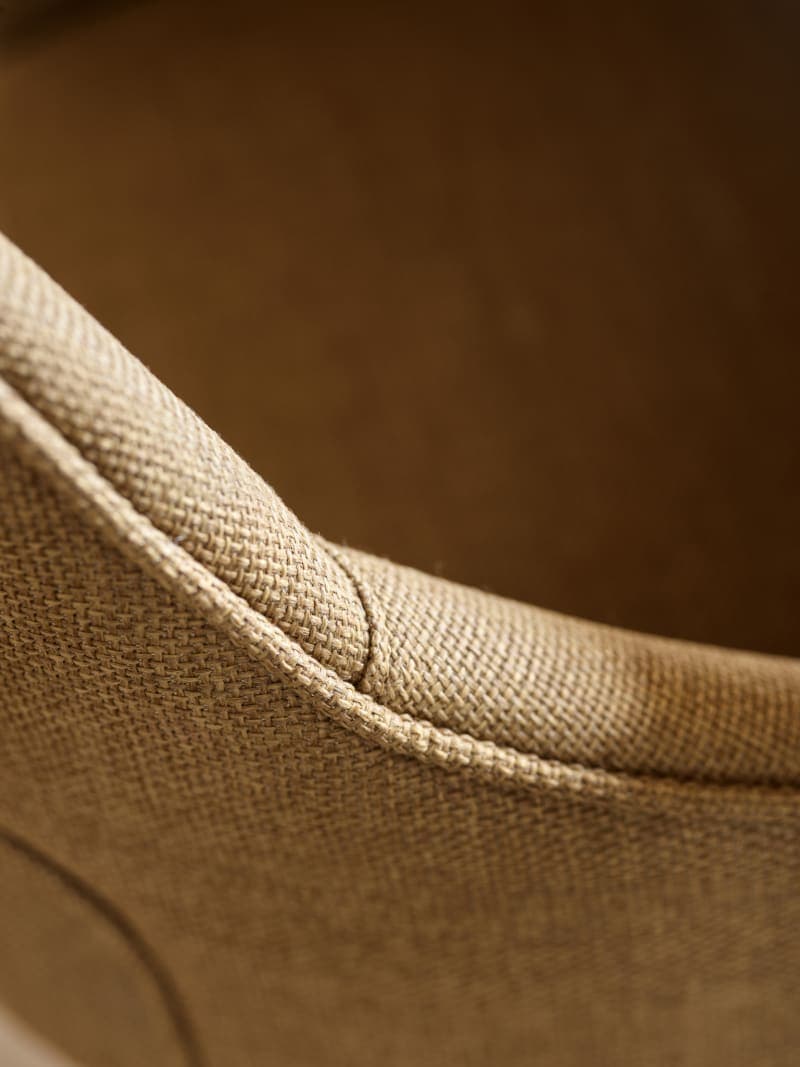
House of Wool works in two genuinely handmade techniques, and they are not interchangeable. A handknotted carpet is built from individual knots tied one by one onto a foundation, a slow, skilled process that produces a dense, hard-wearing piece capable of lasting for generations and carrying detailed pattern. A handwoven carpet is constructed on a loom, a different discipline with its own strengths in texture and structure.
Both are authentically handmade, which already separates them from the large category of rugs that borrow the language of craft without the substance: hand-tufted pieces, for instance, are made with a tool and held together with a glued backing, and they do not behave like a knotted or woven carpet over time. The distinction matters to a specifier because it changes where a piece belongs. A densely knotted carpet earns its keep in a hallway or a hard-used room; a woven piece may be the right answer elsewhere. The technique is not a romantic detail. It is a performance specification.
Stock when you need it, bespoke when the room demands it
House of Wool offers a selected range available from stock in standard sizes, alongside bespoke production in custom sizes and patterns made to a specific brief. For a project this two-track structure is more useful than it first appears.
Stock answers the realities of a timeline: a room that needs to be finished now, a standard footprint, a design already resolved. Bespoke answers the rooms that refuse to be standard, an irregular plan, a specific palette to meet, a pattern that has to belong to one scheme and no other. The judgement a designer actually has to make is which problem they have, and a house that does both well lets that decision be driven by the room rather than by what happened to be available. Few carpet sources are honestly equipped for both ends of that.
What to verify before you specify any wool carpet
There are a handful of questions that predict whether a carpet lasts, and they are worth asking of any maker, House of Wool included. Ask what the wool is and how it is spun, because fibre quality and spin set durability long before pattern does. Ask whether a piece is genuinely knotted or woven rather than tufted, since the construction decides how it wears and whether it can be cleaned and repaired rather than discarded. For a bespoke commission, ask how colour is matched and held, because a custom pattern is only as good as the consistency of its dye. And ask how the piece should be maintained, because a carpet built to last a lifetime only does so if it is treated like one.
These are not difficult questions. They are simply the ones a careful buyer should ask before committing a floor to anyone, and the reason we represent House of Wool is that its answers are the ones a Belgian craft tradition should give.
Specifying House of Wool in Switzerland
For the showrooms, architects and interior designers we work with in Switzerland, House of Wool sits naturally alongside longer-horizon residential and hospitality work, where a floor is expected to outlast several refreshes of everything around it. A handmade pure-wool carpet is a considered, lasting element of a scheme, not a seasonal one, and it should be specified in that spirit.
Robin Gregory Interiors represents House of Wool as part of the furniture agency. Stock ranges, bespoke commissions and project specification run through us, and our interior design studio works with these pieces in its own schemes. If you are weighing a floor for a residence or a hospitality interior, contact us and we will talk through stock versus bespoke and whether House of Wool, or one of the other houses we represent such as Scapa Home Collection and Artisan, is the right fit for the brief.
Frequently asked questions
What does House of Wool make?
House of Wool produces carpets that are handknotted or handwoven from pure, high-quality wool, drawing on a Belgian textile tradition. It offers a selected range in standard sizes from stock as well as bespoke carpets in custom sizes and patterns.
Is a handmade wool carpet always better than a machine-made one?
No. Quality is decided by the wool, how it is spun and how tightly it is worked, not by the word "handmade" alone. A good wool, well made by hand, lasts a generation or more; a poor wool does not, regardless of method. The fibre and the making are what matter.
What is the difference between handknotted and handwoven?
A handknotted carpet is built from individual knots tied onto a foundation, producing a dense, hard-wearing piece that can last generations. A handwoven carpet is constructed on a loom, with its own strengths. Both are genuinely handmade, unlike glued, tufted production.
Can House of Wool make a carpet to a specific size and pattern?
Yes. Alongside the stock range in standard sizes, House of Wool offers bespoke production in custom sizes and patterns tailored to a specific brief, which suits irregular rooms or schemes that need a carpet made to one palette.
Is wool a good choice for high-use interiors?
Generally yes. Wool is naturally durable, resilient and soft underfoot. For demanding areas, construction matters: a densely knotted carpet typically wears better in high-traffic spaces than a lighter woven piece, so the technique should be matched to the room.
How do designers in Switzerland specify House of Wool?
Through Robin Gregory Interiors as the exclusive representative in Switzerland. We handle stock orders, bespoke commissions and project specification, and advise on suitability before anything is ordered. Enquiries from showrooms, architects and designers in Switzerland are handled directly by the agency.
Sources and further reading
General rug-trade references on handknotted versus handwoven construction, the limits of the "handmade" label, and why fibre and spin determine durability more than method.
House of Wool brand information held by Robin Gregory Interiors as the representing agency.
Working on a project, or curious about the brands?
Begin a conversation