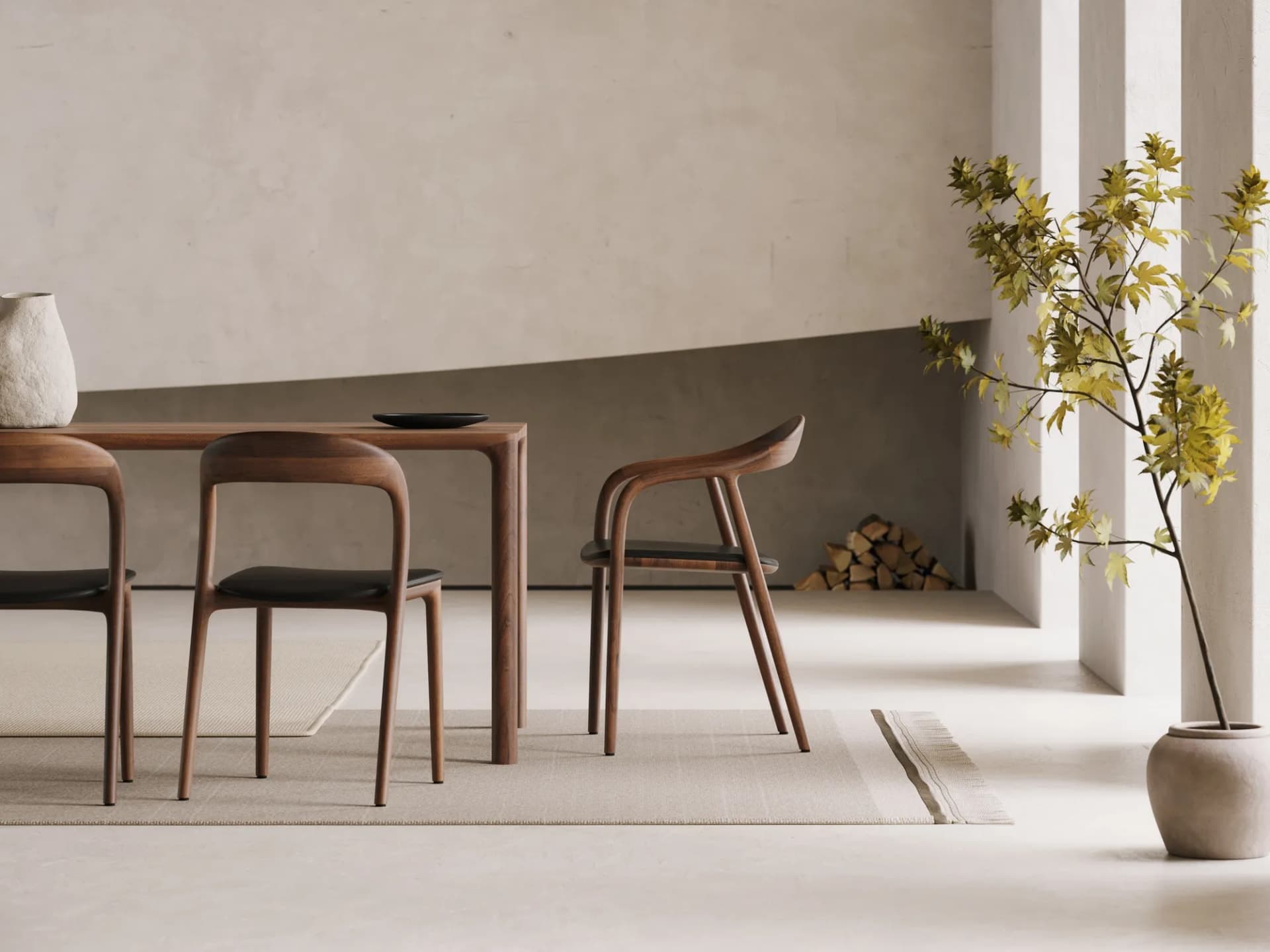
Artisan is a Bosnian furniture house that keeps the entire making process in its own hands, from the raw log through to the finished piece, and that single decision is what separates its work from most of what reaches a European specification.
On this page
Introduction
Artisan is a Bosnian furniture house that keeps the entire making process in its own hands, from the raw log through to the finished piece, and that single decision is what separates its work from most of what reaches a European specification. Almost everything else a designer can buy at this level is assembled across a supply chain: timber from one source, panels from another, finishing from a third. Artisan refuses that division of labour, and the reason is not romance. It is control over the variables that decide whether a piece is still sound in twenty years.
One company, the whole process
Most furniture failures are not failures of design. They are failures of moisture, grain selection and joinery, decided long before a piece is styled for a photograph. When those decisions are spread across a sawmill, a board supplier and an assembler, no single party is accountable for how the finished article behaves once it is living in a heated room.
Artisan holds all of it. The company selects and dries its own timber, machines and shapes it, and finishes the piece, on its own site. For a specifier this is the point worth understanding before the catalogue: the people who chose the wood are the same people who built the table, which means the chain of responsibility does not break halfway through. Provenance here is not a marketing word. It is the literal answer to the question a careful client should ask, which is who actually made this, and from what.
Why drying is the part nobody sees
The most consequential thing Artisan does happens before any tool touches the wood. It dries its timber naturally, with around 3,500 square metres of canopy space and a drying capacity of roughly 1,150 cubic metres. That is industrial scale applied to the slowest, least glamorous stage of the work, and it is the right place to spend it.
A freshly felled log carries somewhere between 30 and 45 per cent moisture. Furniture-grade timber in Europe is generally worked at around 12 per cent, with a tolerance of a few points either side, because that is roughly where wood settles in a heated interior. Get this wrong and nothing else matters: a beautifully joined cabinet built from timber that was never brought down correctly will move, split or twist once it spends a winter in a dry Alpine room.
It would be easy, and dishonest, to claim that natural drying is simply superior to kiln drying. It is not. Natural drying is gentler and tends to leave less internal tension in the wood, but it is slower and more variable. Kiln drying is faster and more uniform and kills any pests in the timber, but rushed badly it introduces stress and dulls colour. What actually matters is neither method as a slogan: it is whether the timber reaches the correct, stable moisture content for where the piece will live, with its internal stresses relieved. The discipline is in the control, not the method. We would rather represent a maker that treats drying as the main event and the joinery as the reward, because that is the order in which furniture either survives or does not.
Precision without losing the hand
The other half of the proposition is consistency. Artisan runs its making across manufacturing facilities of more than 30,000 square metres and keeps a standing stock of around 4,000 cubic metres of wood, supported by five-axis CNC machining.
For a private client buying one table, the CNC barely matters. For an architect or designer specifying twelve rooms, it is decisive. Five-axis machining produces complex geometry to a tolerance a hand can rarely repeat across a batch, and the standing timber stock means a multi-room or hospitality order can be cut from coherent material rather than assembled from whatever arrives over the following six months. Anyone who has watched a project go wrong on mismatched batches knows the value of that, and it is rarely written down anywhere a client can see it.
This is not a single-bench workshop, and it should not pretend to be. It is real capacity in the service of repeatability. Some buyers specifically want the irregular signature of one maker's hand, and for them this is the wrong house. Artisan's case is the opposite one: the same considered piece, made the same way, whether you order one or forty.
What to verify before you specify any solid-wood maker
A maker will rarely volunteer the questions that actually predict whether their furniture lasts, so it is worth knowing them before you commit a project to anyone, Artisan included. Ask what moisture content the timber is worked to, and for which destination climate; a maker who cannot answer in numbers is guessing. Ask whether drying happens in-house or is bought in, because a bought-in board is a variable nobody on the project controls. Ask how a contract quantity is batched, since consistency across a run is decided at the timber yard, not on the finishing line. And ask what happens when a piece moves slightly in year three, because solid wood is a living material and any honest maker will tell you it behaves like one rather than promising it never will.
These are not gotchas. They are the ordinary questions a careful specifier should be able to put to any house at this level, and the reason we represent Artisan is that the answers hold up. A vertically integrated maker can answer all four from a single source of truth, which is the practical advantage of controlling the process rather than the marketing version of it.
What it means to specify Artisan
For the showrooms, architects and interior designers we work with across Switzerland and Liechtenstein, the questions that decide a specification are practical: lead time, finish range, how a bespoke size or detail is handled, and whether a contract quantity will arrive consistent. Artisan answers those well, which is why we represent it.
Robin Gregory Interiors sits between the maker and the project. The full collection, materials and finishes are set out on the Artisan agency page, and the complete catalogue is available to download there. Bespoke dimensions, contract quantities and project specification run through us as the furniture agency, the same way our interior design studio specifies these pieces in its own work. If you are weighing Artisan for a residence, a hospitality fit-out or a showroom range, contact us and we will talk through whether it is the right house for the brief, or whether Scapa Home Collection sits closer to it. Not every project wants solid wood at this weight, and we would rather say so early than late.
Working on a project, or curious about the brands?
Begin a conversation